


One in 10 US adults older than 65 will experience dementia, and another 22% will have some form of mild cognitive impairment, according to Columbia University researchers.
The good news is that you can reduce your risk of Alzheimer’s Disease and dementia.
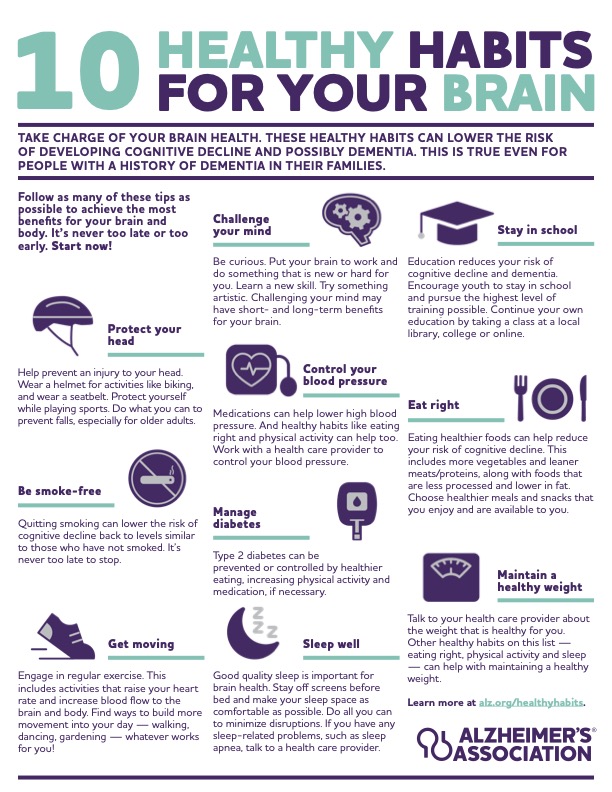
Here are 10 positive changes that you can make to lower your risk for cognitive decline and improve your overall health, according to the Alzheimer’s Association.
1. Protect Yourself from Brain Injuries
Traumatic brain injuries have been linked to an increased risk for developing dementia.
According to a published study examining the relationship between injury and cognitive decline, traumatic brain injuries can increase dementia risk between 2-and 4-fold.
One of the best ways of preventing traumatic brain injury is to protect your noggin when doing physical activity and engaging in sports.
This means putting on a helmet when riding a bike and wearing protective head gear to prevent falls, especially if you are an older adult.
2. Ditch Smoking
Smoking is not only a risk factor for heart disease and lung cancer, but also dementia.
According to the Alzheimer’s Association, people who smoke heavily during the middle of their lives have a 50% increased risk for dementia later in life.
Therefore, quitting smoking can significantly lower your chances of developing cognitive decline in the future.
Quit smoking with Quitxt, a bilingual service from UT Health San Antonio that sends texts messages to smartphones to help South Texas adults quit smoking.
To join Quitxt in English, text “iquit” to 844-332-2058.
For Spanish, text “lodejo” to 844-332-2058.
3. Exercise Your Body
Dozens of studies have found that staying active is a key way to keep your brain and cognitive health in peak shape.
For instance, studies have shown that dance can improve memory retention.
Other studies have shown that just five extra minutes of physical activity can lower your risk for Alzheimer’s and related dementias.
It has to do with raising your heart rate and keeping the blood flowing to the brain and body, according to the Alzheimer’s Association.
Get your body and brain moving by dancing, walking, gardening — anything that gets you up and moving.
You can also follow the recommended physical activity guidelines for your age group and health situation.
4. Exercise Your Brain
Like your body, your brain also needs exercise.
You can exercise your mind by challenging yourself to try or learn something new.
Getting the cogs moving in your brain can be as simple as picking up a new hobby or skill, or engaging the artistic and creative side of your brain, according to the Alzheimer’s Association.
5. Pursue Higher Education
Those who have sought out higher education not only have a better chance in the job market but also have a much lower risk of developing dementia.
Challenge your brain by taking a few courses at the local library, college, or online.
6. Control Your Blood Pressure
Higher blood pressure can lead to many serious adverse health effects and conditions, including heart attacks, stroke, or kidney disease.
Also known as hypertension, high blood pressure is caused when the blood around the artery walls is always high, according to the American Heart Association.
High blood pressure is also a risk factor for obesity, diabetes, and associated with cognitive decline.
7. Manage Diabetes
Diabetes continues to threaten public health.
The chronic disease can increase your risk for certain diseases, including cancer, Alzheimer’s and dementia.
While there is no cure for diabetes, there are certain lifestyle changes you can implement to reduce the effects of diabetes and minimize risk of diseases in the future.
To manage your diabetes symptoms, maintain a healthy diet that is low in sugar and high in fiber, engage in plenty of exercise, and monitor your blood sugar regularly.
Making these positive changes can also have an impact on your overall health, including your cognitive health.
8. Maintain a Healthy and Balanced Diet
Maintaining a healthy and well-balanced diet is vital for maintaining a healthy lifestyle.
It can also have a positive impact on your cognitive health!
Having a diet that is rich in vegetables and leaner meats and proteins is key along with minimizing processed foods and choosing ones that are lower in fat, according to the Alzheimer’s Association.
Check out the latest federal dietary guidelines.
9. Maintain a Healthy Weight
Making changes like eating healthier and exercising are key to maintaining a healthy weight.
But did you know that maintaining a healthy weight can also reduce your risk of cognitive decline?
Taking care of your body directly correlates to taking care of your mind.
10. Get a Good Night’s Rest
Lack of sleep is linked to several adverse health effects, including increased risks for type 2 diabetes, obesity, hypertension, and weakened immunity, according to the National Institutes of Health (NIH).

The truth of the matter is that sleep affects both your physical and emotional health.
From sleep apnea to spending too much time on screens instead of sleeping, getting too little sleep can alter your mood, concentration, stress level, and more.
This can negatively impact your relationships, career, and education.
It can also negatively impact your physical and cognitive health.
A recent study linked lack of sleep to increased risk for Alzheimer’s Disease.
If there is anything impeding you from sleeping, the Alzheimer’s Association suggests seeking help from a health care provider.
Addressing Alzheimer’s and Dementia in South Texas
Alzheimer’s and related dementias continue to ravage communities and families in South Texas, where many Latinos call home.
There are many societal and background-prevalent factors that contribute to inconsistencies in the Alzheimer’s and dementia care continuum.
Many of these factors stem from some of the modifiable risk factors included on this list.
To address some of these inconsistencies, UT San Antonio launched the San Antonio Center for Alzheimer’s Disease and Related Dementias (AD/ADRD) Population Aging and Social Studies (CAPAS), which is funded by the National Institute on Aging.
Led by Drs. Rebeca Wong and Fernando Riosmena, CAPAS seeks to bring together multidisciplinary groups of experts and research networks in demography, sociology, AD/ADRD epidemiology, neuropsychology, public health issues, and experience conducting longitudinal studies for AD/ADRD research and Latino aging.
“By combining our strengths, we can address Alzheimer’s disease from every angle — from molecules and biomarkers to families, neighborhoods and communities,” Dr. Wong told UT San Antonio Today.
For more information on Alzheimer’s Disease, dementia, or what researchers are doing to improve health outcomes in aging Latino adults, please visit the CAPAS center website.
Additional Alzheimer’s resources for patients and caregivers are available in English and Spanish on the Alzheimer’s Association website.
Editor’s note: This blog post was curated and published by Salud America! with support from the San Antonio Center for Alzheimer’s Disease and Related Dementias Population Aging and Social Studies (CAPAS) at UT Health San Antonio, funded by the National Institute on Aging. CAPAS is striving to address issues related to the aging Latino population in South Texas.